Static IP slot configuration
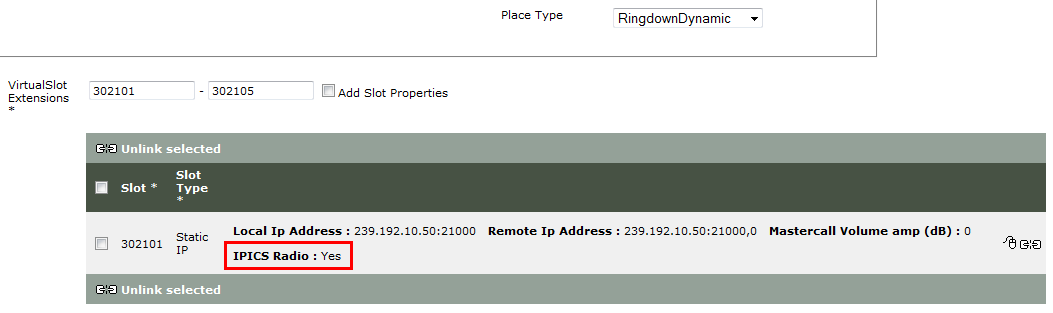
To integrate to Cisco Instant-connect, a static IP slot must be created (refer to Static IP slot configuration). Then the administrator must enable Instant-connect Radio:
Fine tuning (expert only)
The OLDCB service is in charge of TPO media. The configuration is done by Boot Settings (TPOs) on TSS Console.
•TPO version 7.4 or later: the configuration is located in the TSS console management under following sections: oDevice Management / TPOs / Edit TPO / Boot Settings / Expert Mode / Global oDevice Management / TPO Clusters / Edit TPO Clusters / Boot Settings / Expert Mode / Global oDevice Management / Zones / Edit Zone / Boot Settings / Expert Mode / Global
•TPO version 7.3 or olde : the configuration file is located in <Windows System directory>\OLDCB.cfg.
The following keys is dedicated to Instant-connect:
•OLDCB.ISTREAM.PAYLOAD.RADIOTALKERIDMSG: indicates the RTP payload for talkerId message. The default value is 110
•OLDCB.ISTREAM.PAYLOAD.RADIOCONTROLMSG: indicates the RTP payload for radio control message. The default value is 109
•OLDCB.NOTIFY.MULTICASTPASSIVE.JITTER.EMPTYDELAY: OLDCB sends a RTP timeout event to TPO application when no RTP packets are received from the remote party. This key indicates the timeout value for the specific multicast IP input stream. The default value is 2000 ( 2 seconds).
•OLDCB.NOTIFY.RADIOCONTROLMSGID.ALWAYS: Usually OLDCB received 3 or 4 times the save Radio Control message (same message Id) in a short time. In order to limit the notification to TPO application, OLDCB notified only once when receiving 3 or 4 Radio Control message with the same message Id. But we noticed that Instant-connect server used only message Id "0" to notify all the Instant-connect radio status.
This key contains the message Ids in which OLDCB will always notify TPO.
Example:
OLDCB.NOTIFY.RADIOCONTROLMSGID.ALWAYS = 0, 1
It means that OLDCB will always notify TPO application for message Id 0 and 1 even these message are sent several times.
WARNING: Instant-connect version 4.8 or later does not use RTP payload 110 for talkerId message. This message is handled by RTCP in SDES packet.
To be compatible with Instant-connect version 4.8, TPO must activate RTCP mode to take into account the talkerId message.
•OLDCB.GLOBAL.RADIO.TALKERID.USERTCP = true,false Use RTCP for talker ID in Instant-connect version 4.8 or later.
The default value is false.
•OLDCB.NOTIFY.ENDTALKERID.EMPTYDELAY = 2000 Define the End Talker timeout (in millisecond).
Instant-connect 4.8 uses RTCP to transmit the Talker ID. It does not transmit the End-Talker ID message to indicates the end of voice data transmission.
Then TPO uses the mechanism of RTP timeout to notify the End-Talker ID to the turret. The default value is 2000.
•OLDCB.GLOBAL.RADIO.TALKERID.SENDPERIOD = 50 Define the Sending Period of the Talker ID. The default value is 50.
When a user speaks on a radio call, TPO sends periodically the Talker ID.
This parameter allows to define the period.
The value is a multiple of the tick value 20 ms.
Example:
if we define 50, the 50*20 = 1000 ms
if we define 250, the 250*20 = 5000 ms
|


