Usage


Usage |
|
| Enterprise Telephony > Common > Call Transfers > Simplified Transfer |
Traditional transfer sequence
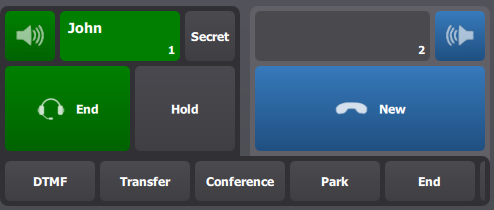
In a traditional transfer sequence, transferring a call with John to a target remote party Jack is performed the following way:
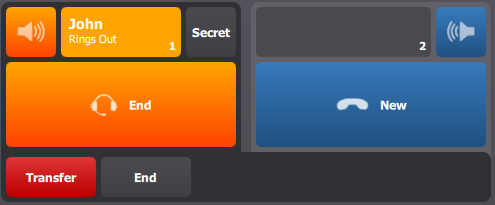
1.Establish a call with John on a handset; 2.Press the Transfer button to initiate the transfer operation; 3.Establish a new call with Jack on the same handset (the Transfer button turns red); 4.Press the Transfer button to validate the transfer operation.
However, sometimes the source call with John is already on-hold. The sequence is then:
1.Resume the call with John on a handset; 2.Press the Transfer button to initiate the transfer operation; 3.Establish a new call with Jack on the same handset (the Transfer button turns red); 4.Press the Transfer button to validate the transfer operation.
This second sequence requires resuming the call with John, and then putting it on-hold (for transfer) again, which is not so smooth for the remote party.
Simplified transfer sequence
Using the new simplified transfer sequence, the whole operation is faster when the source call is already on-hold:
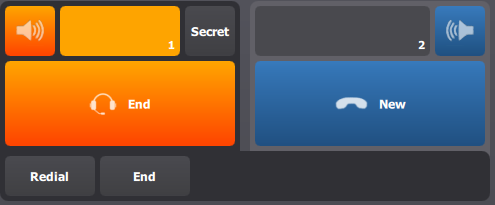
1.Establish a new call with Jack on any handset (the Transfer button turns red); 2.Press the Transfer button to validate the transfer operation.
This simplified sequence applies to both attended (as described above) and unatended transfers.
As mentioned in the sequence, the target call does not need to be hosted on the same handset as the source was originally on. |