SIP STX Lines to LSE


SIP STX Lines to LSE |
|
| Trading and C&C > Turret Proxy To Open communication (TPO) |
IntroductionLondon Stock Exchange Group (LSE.L) is a diversified international market infrastructure and capital markets business sitting at the heart of the world's financial community in London. STX is the 20 year old BT FeatureNet based fast and secure private telephone network used by member firms and other industry professionals across the UK, Republic of Ireland and the Channel Islands. White labelled and resold to the market by LSE.STX enables you to reach anybody on the network through five-digit dialling for a flat fee. This service was presented to LSE member firms as a 2Meg DPNSS bearer that is normally terminated directly on the turret trading system or PBX of the member institution.
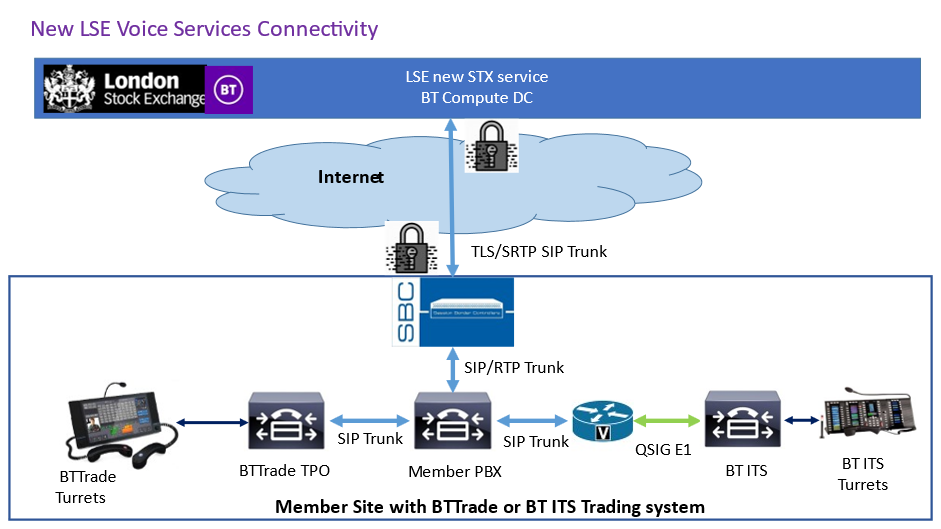
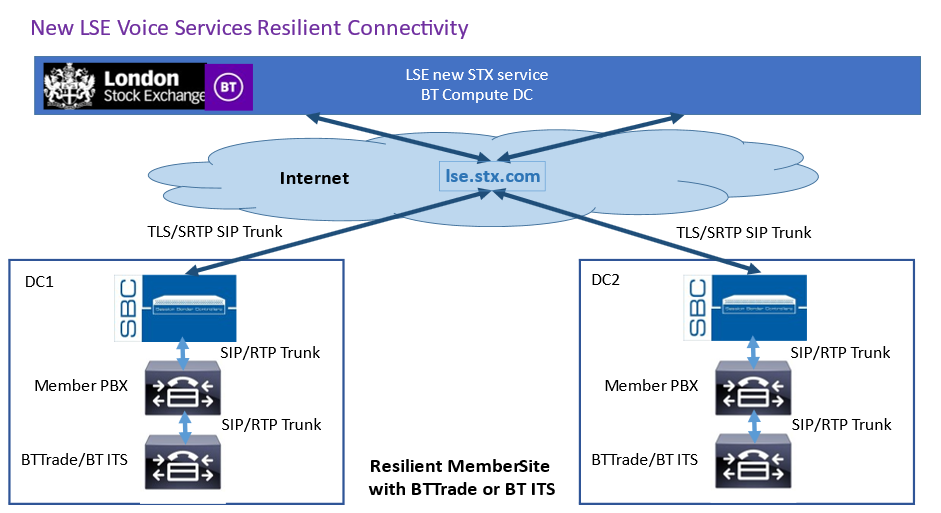
BT FeatureNet is becoming end of life April 2020. LSE and BT have worked together to replace it with a Digital Transformation of STX to a cloud based application provided by BT. The new system supports connections from web based clients and smart phone clients however this document is only concerned with how you would connect the new service to a Turret Trading System or PBX which will be via an internet based SIP trunk.
Overview |
Trunk Parameter |
Value |
|---|---|
SIP Signalling |
SIP over TLS |
TLS Port |
TCP 5069 ( May be member specific ) |
TLS signed certificates |
Provided by LSE |
SIP Registration Required |
No |
SIP Digest Authentication Required |
No |
SIP Early Offer Required |
Yes ( Late offer not supported ) |
SIP Messages Supported |
INVITE, ACK, CANCEL, OPTIONS, BYE, REFER, SUBSCRIBE, NOTIFY, INFO, PUBLISH, MESSAGE |
SIP OPTIONS |
Sends every 60sec |
SIP Session Timers |
Not enabled by LSE ( This may change ) |
SRTP Required |
Yes |
SRTP ciphers |
AES_CM_128_HMAC_SHA1_80 |
SRTP port range |
Provided by LSE |
SRTP Codec |
G711alaw at 20ms ( Note no G711ulaw) |
SRTP DTMF |
telephone-events 101 |